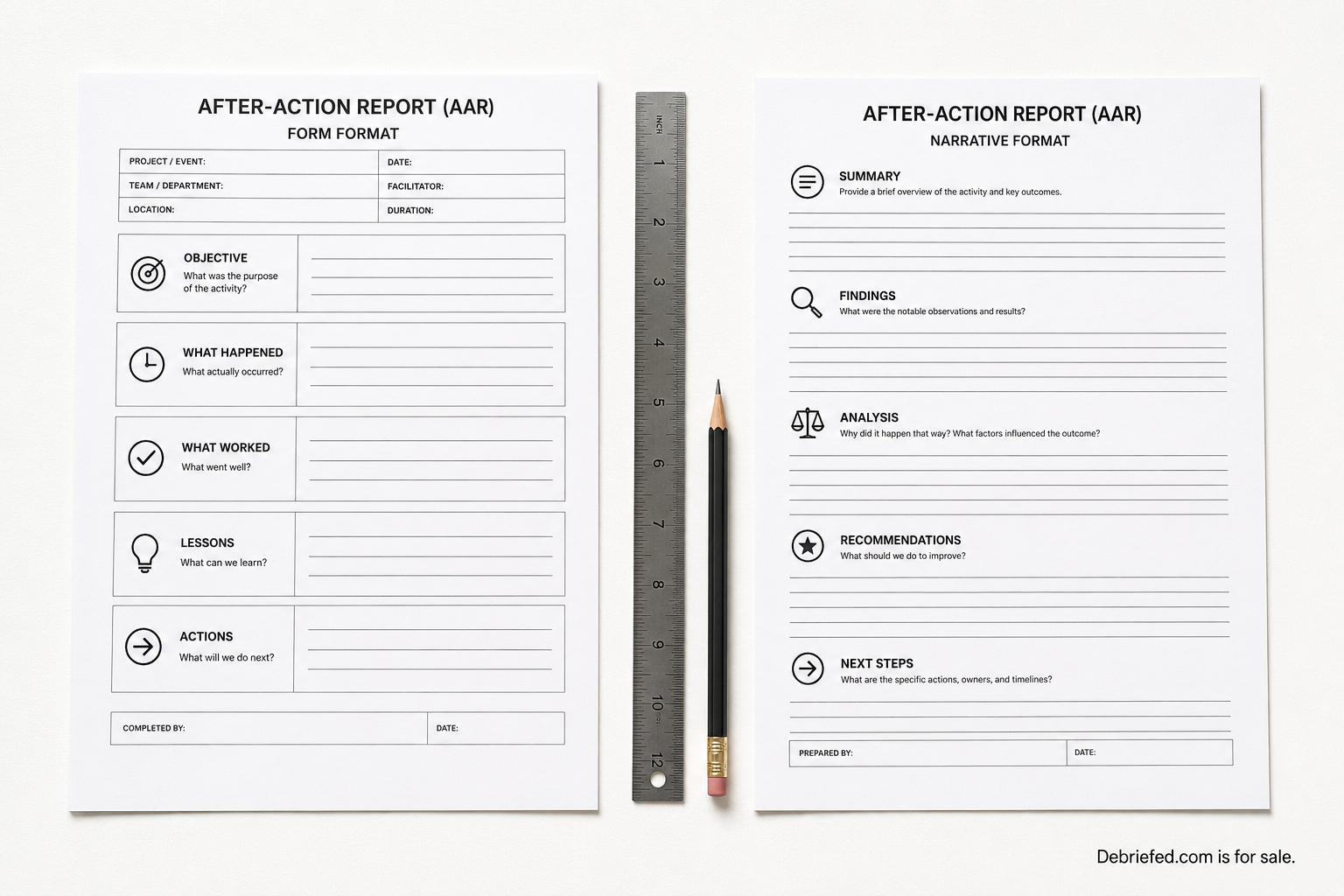
Teams use several names for the conversation after an event. The terms overlap, but timing, tone, scope, and expected output differ. Choose the format based on the decision the team needs to make, the freshness of evidence, the consequence of the event, and the amount of preparation available. The label matters less than setting accurate expectations.
A hotwash is immediate. Participants gather at the end of an exercise, response, shift, or event and capture fresh observations before they disperse. It is useful for perishable detail, urgent safety corrections, and questions that need later investigation. It should remain short and should not pretend to deliver a complete causal account while people are tired and evidence is incomplete.
A debrief is the broadest term. It can be a short operational check, a guided reflection, an information-gathering interview, or a team learning session. Define the purpose whenever using the word. Participants should know whether the session concerns wellbeing, performance, intelligence collection, factual reconstruction, or improvement decisions.
An after-action review compares the intended result with the actual result, explores why the difference occurred, and identifies what to sustain or change. It works best soon after the event with the people who performed the work. A neutral facilitator, shared evidence, and assigned actions make the method more reliable. See Rootly’s postmortem meeting guide for a useful public treatment of this part of the work.
A postmortem usually follows a failure or incident and often emphasizes causal analysis, impact, detection, response, and prevention. Software and reliability teams commonly use the term. A blameless postmortem examines the system conditions around decisions while preserving accountability for improvements. It often produces a formal record for a broader audience.
A retrospective is usually tied to a recurring team cadence, such as the end of an iteration. It focuses on how the team worked and what experiment to try next. The event may be ordinary rather than exceptional. Regular cadence can make retrospectives psychologically safer, though repetition can also make them shallow unless facilitators vary the evidence and questions. See SI Labs on retrospectives for a useful public treatment of this part of the work.
Choose a hotwash when immediate recall is the main asset and the team needs to flag urgent issues. Capture observations, safety concerns, missing facts, and names for follow-up. Schedule a fuller review before leaving. The hotwash becomes an input to later analysis rather than the final record.
Choose an AAR when there was a clear plan or intended result and the team can compare it with performance. The four-question structure works for projects, operations, campaigns, exercises, and launches. It is especially useful when the group needs to preserve both successful practices and corrections. See Shamaym’s comparison for a useful public treatment of this part of the work.
Choose a postmortem when an incident demands a durable causal account, impact analysis, and prevention work. Give investigators enough time to collect records and interview participants. Separate urgent remediation from deeper corrective actions so restoration pressure does not narrow the explanation.
Choose a retrospective when a stable team needs frequent improvement at a manageable scale. Keep experiments small, assign them, and check the result at the next session. Use an AAR instead when a specific event, explicit plan, or cross-functional participant group requires a fuller reconstruction.
Formats can be sequenced. A team can hold a hotwash immediately, conduct interviews the next day, run an AAR after evidence is assembled, and issue a report with an improvement plan. Naming each stage helps participants understand whether they are supplying observations, testing causes, or approving changes. See Scope Safety on hotwashes and reports for a useful public treatment of this part of the work.
Avoid combining every purpose into one meeting. Emotional support, legal investigation, performance management, intelligence collection, and team learning have different confidentiality and authority requirements. A single room cannot always serve them safely. Route each need to the right process and explain the boundaries.
Whatever label is selected, publish a simple charter: event, objective, participants, facilitator, evidence, questions, output, distribution, and follow-up date. That one page reduces confusion and gives the facilitator permission to protect scope.
Evaluate the format by its result. Immediate notes should feed later work. A recurring retrospective should change an experiment. An AAR should produce agreed findings and actions. A postmortem should connect causes to prevention. The vocabulary is useful only when it helps a team choose the right discipline.
Prepare a lightweight checklist for the method and keep it beside the team’s normal planning material. The checklist should name the event boundary, evidence, participants, decision owner, record location, action tracker, and follow-up date. Repetition makes the process easier to start and reduces dependence on one experienced facilitator. The checklist can evolve when reviews reveal a better question or a recurring gap.
Pay attention to language during the session and in the record. Replace broad judgments with descriptions of conditions, behavior, sequence, and consequence. Ask what a camera, system record, or direct observer would have captured. Concrete language makes disagreement easier to examine and gives an action owner a clearer condition to change. It also helps a future reader decide whether the lesson applies in a different setting.
Leaders should review the health of the process across several events. Look for recurring causes, overdue actions, repeated exceptions, and successful practices that deserve wider adoption. This portfolio view can reveal a system issue that no single event makes obvious. Keep the original context attached so aggregation does not flatten different situations into a misleading score.
Facilitators and report owners improve through their own review cycle. After each session, note which question produced evidence, where the group became vague, which participants entered late, and whether the final actions matched the findings. Adjust the next agenda based on those observations. The review method should demonstrate the same learning behavior it asks from the team.
The final test is practical. A review has succeeded when another person can understand what happened, why the finding matters, what will change, who owns that change, and when the team will check the result. A polished meeting without those elements is discussion. A concise record with those elements becomes part of the operating system.