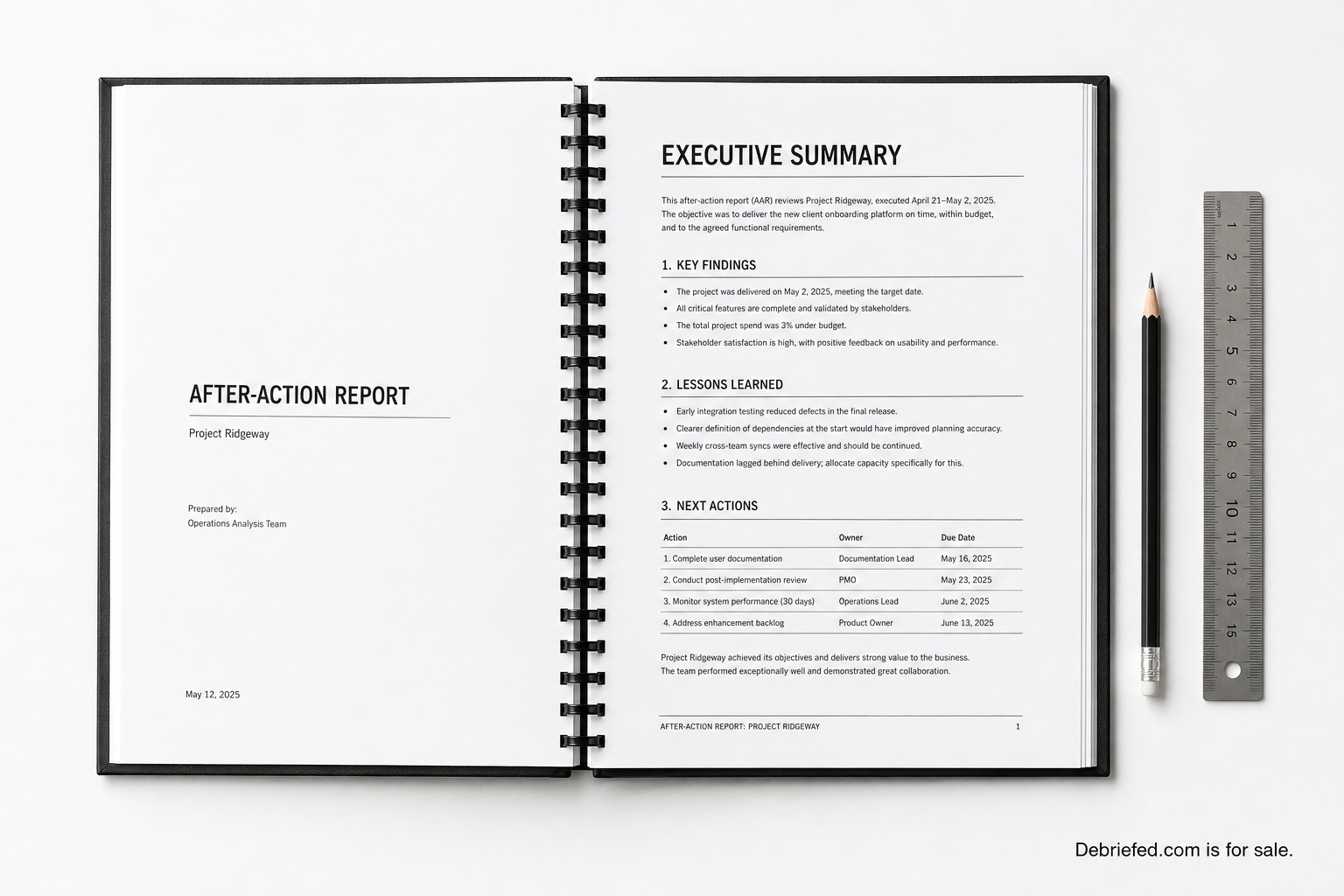
An after-action review is the live learning conversation. An after-action report is the durable record produced from evidence and the review. Confusing them creates two common problems: teams turn the meeting into a line-by-line document edit, or they hold a useful conversation and leave no record that can guide later work. Treat the meeting and report as connected outputs with different jobs.
The review gathers perspectives, tests the sequence, and explores causes. It benefits from interaction because one observation prompts another and competing accounts can be examined in real time. The report preserves the agreed facts, material uncertainties, findings, and improvement actions. It benefits from editorial control because a future reader needs a coherent record rather than a transcript.
Choose the report owner before the meeting. The owner can be the facilitator, an analyst, or a participant with enough access to verify evidence. They should understand the event without being so invested in one account that contradictory evidence disappears. Give the owner a deadline and a named approver for factual and handling questions. See FEMA PrepToolkit templates for a useful public treatment of this part of the work.
Start the document with a compact executive summary. State the event, date, scope, intended result, actual result, two or three decisive findings, and the highest-priority changes. Write this section last, after the evidence and actions are stable. A reader should understand the consequence without reading every detail.
Follow with scope and methodology. Identify the period covered, participating roles, records reviewed, interviews conducted, and material limitations. This section tells future readers how much confidence to place in the account. It also prevents a narrow review from being mistaken for a complete investigation.
Build a factual timeline before writing findings. Use a table or clear sequence with time, event, source, and any uncertainty. Keep interpretation out of the timeline unless it is labeled. When two reliable sources conflict, record the conflict and the resolution status rather than selecting the more convenient account.
Write observations as precise statements about conditions and results. Group related observations into findings only when the evidence supports a common cause or consequence. Avoid vague labels. Communication failed says little. The approval change reached the field team after execution began identifies a condition that can be examined and corrected.
For each finding, explain why it matters and what evidence supports it. Separate root causes, contributing factors, and effects. Some events have several interacting causes, so a single-cause story can produce a weak fix. State confidence and unanswered questions where the record remains incomplete.
Create an improvement plan that stands on its own. Each action needs a clear description, accountable owner, due date, priority, resources or dependencies, and a measure of completion. An office or committee is not an owner. Name the role that holds authority and identify the person through the organization’s working system. See FEMA improvement-planning material for a useful public treatment of this part of the work.
Keep raw notes, recordings, sensitive details, and the distributed report under appropriate access rules. The public or broad internal version may require redaction while an authorized record preserves provenance. Decide retention and correction procedures before circulation. Participants should be able to fix factual mistakes without erasing legitimate disagreement.
Use a short review cycle for the draft. Ask participants to check facts, then ask the accountable leader to approve actions. Set a firm deadline so editing does not become avoidance. Publish the final version where later teams can find it, and link every action into the normal work tracker. See LegalClarity’s process discussion for a useful public treatment of this part of the work.
An AAR/IP combines an after-action report with an improvement plan. The format is common in exercise and emergency-management settings because it connects observed capabilities with corrective action. Even when an organization uses a different template, the underlying discipline is valuable: findings and assignments belong together.
At the next kickoff, retrieve relevant reports and read the actionable portions. Search by context, system, capability, and condition rather than title alone. Archive quality is measured by reuse. A beautifully formatted report that cannot be found when the next plan is made has failed its most important future reader. See Workhint’s review process overview for a useful public treatment of this part of the work.
The report should be proportionate. A routine review may need two pages. A complex event may require appendices, evidence tables, and a governed improvement plan. Length follows consequence, uncertainty, and audience. Clarity remains the standard in every format.
Prepare a lightweight checklist for the method and keep it beside the team’s normal planning material. The checklist should name the event boundary, evidence, participants, decision owner, record location, action tracker, and follow-up date. Repetition makes the process easier to start and reduces dependence on one experienced facilitator. The checklist can evolve when reviews reveal a better question or a recurring gap.
Pay attention to language during the session and in the record. Replace broad judgments with descriptions of conditions, behavior, sequence, and consequence. Ask what a camera, system record, or direct observer would have captured. Concrete language makes disagreement easier to examine and gives an action owner a clearer condition to change. It also helps a future reader decide whether the lesson applies in a different setting.
Leaders should review the health of the process across several events. Look for recurring causes, overdue actions, repeated exceptions, and successful practices that deserve wider adoption. This portfolio view can reveal a system issue that no single event makes obvious. Keep the original context attached so aggregation does not flatten different situations into a misleading score.
Facilitators and report owners improve through their own review cycle. After each session, note which question produced evidence, where the group became vague, which participants entered late, and whether the final actions matched the findings. Adjust the next agenda based on those observations. The review method should demonstrate the same learning behavior it asks from the team.
The final test is practical. A review has succeeded when another person can understand what happened, why the finding matters, what will change, who owns that change, and when the team will check the result. A polished meeting without those elements is discussion. A concise record with those elements becomes part of the operating system.