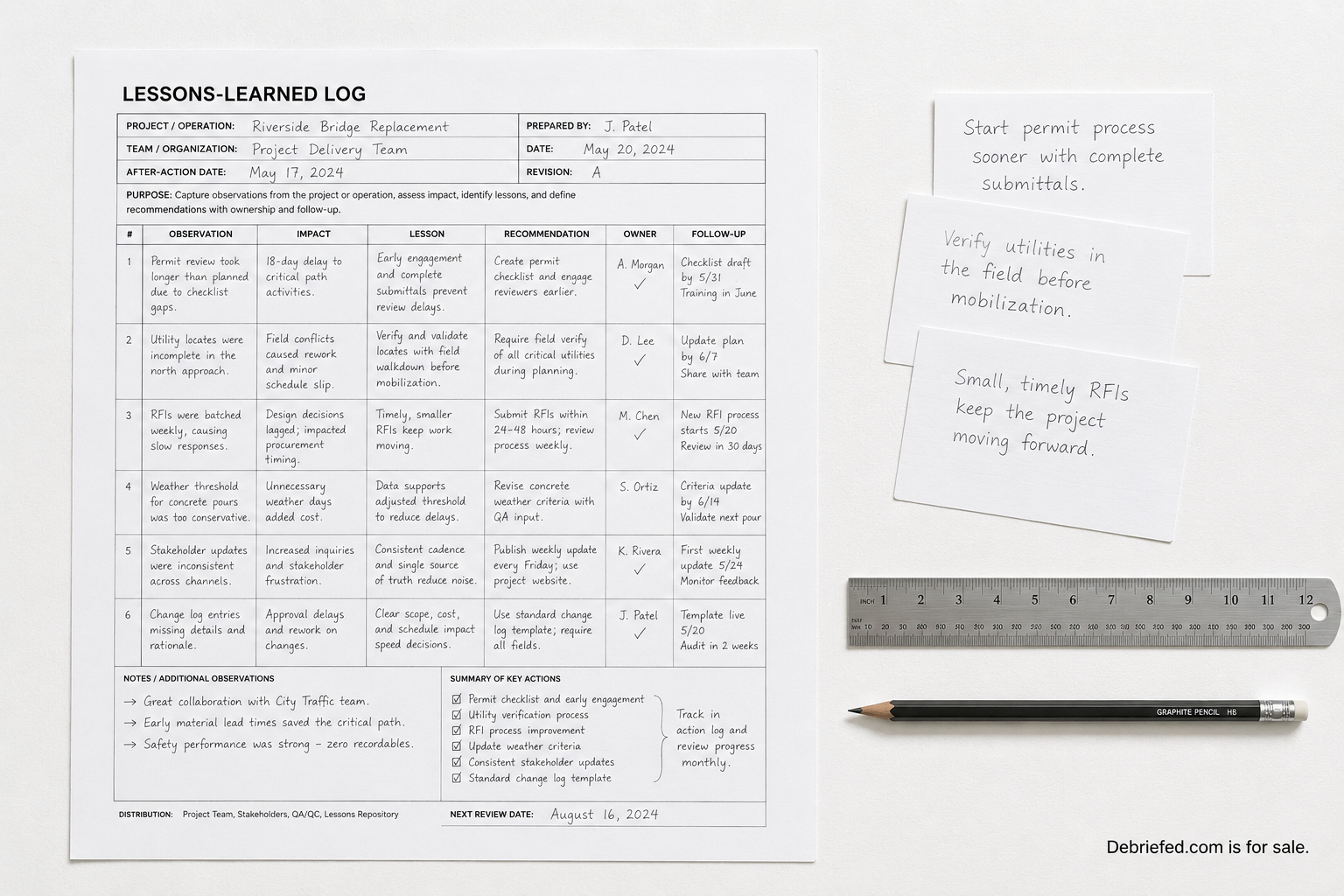
A lesson is useful only when a later team can find it, understand the context, and change a decision. Many organizations capture observations at closeout and call the folder a lessons-learned system. The real process extends from evidence and editorial review through indexing, ownership, retrieval, and confirmation that the lesson still applies.
Begin with a specific observation from a review. State the intended result, what happened, and the evidence. Then explain the condition that contributed to the outcome. A useful lesson connects context, cause, consequence, and an advised action. General advice such as communicate earlier is too weak to guide another team.
Write the lesson for a reader who was absent. Define local terms, identify the type of work, and include enough sequence to make the finding credible. Remove names that add no operational value while preserving roles and authority. A future reader needs to recognize whether their situation is similar enough for the advice to apply. See Rework’s lessons-learned library for a useful public treatment of this part of the work.
Separate observations, findings, lessons, and actions. An observation reports a fact. A finding explains its significance. A lesson states reusable knowledge. An action changes a process, tool, decision, or assignment. Mixing these forms produces vague records and makes ownership difficult.
Give every lesson provenance. Link it to the source event, review date, supporting record, approving role, and confidence level. Record contradictory evidence and conditions that limit reuse. Provenance lets a later team judge the lesson rather than accept an orphaned sentence as institutional truth.
Use a controlled set of fields alongside plain language. Helpful fields include activity, phase, capability, system, location type, trigger, consequence, and affected role. Keep the vocabulary small enough to govern. Add synonyms so people can search in their own language without multiplying categories. See Pisys on turning lessons into action for a useful public treatment of this part of the work.
Assign an owner who can maintain the lesson. The owner answers questions, reviews new evidence, updates the guidance, and retires entries that no longer apply. Ownership should sit near the process or capability involved, not with a temporary project office that disappears after closeout.
Edit before publication. Merge duplicates, split entries that contain several causes, check that the recommendation follows from evidence, and protect sensitive information. A short editorial queue improves trust. Users stop consulting a library when every search returns repetitive or unsupported advice.
Design retrieval around planning moments. Surface relevant lessons in kickoff checklists, risk reviews, playbooks, templates, and approval gates. Search alone asks the next team to remember that knowledge exists. Contextual prompts bring the lesson forward when the related decision is being made. See Work Management’s comparison for a useful public treatment of this part of the work.
At kickoff, ask which prior events resemble the new work, which assumptions deserve testing, and which lessons require a changed plan. Record whether the team accepted, adapted, or rejected each relevant lesson and why. This creates a feedback loop instead of a one-way archive.
Measure use rather than collection. Track whether lessons appear in plans, whether owners complete associated changes, whether users rate results as relevant, and whether repeat failures decline. Entry count can reward clutter. Retrieval and changed decisions are stronger signals.
Review the library on a schedule. Merge emerging duplicates, update links, test owners, and retire obsolete guidance while preserving history. Mark replaced lessons clearly. A current collection earns more trust than a huge collection whose authority is impossible to judge. See monday.com’s lessons template guide for a useful public treatment of this part of the work.
Choose technology after defining the workflow. A spreadsheet can support a small governed register. A document system may work when metadata and search are consistent. A dedicated database becomes valuable when volume, access rules, relationships, and contextual delivery exceed those tools.
Treat failed retrieval as an incident worth reviewing. Ask what the user searched, which language they used, where the relevant lesson lived, and why it was absent from the planning flow. Improve metadata, synonyms, placement, or prompts based on that evidence.
Close the loop with the original contributors. Show how their observation became a lesson and where the resulting action landed. Visible use encourages candid future participation. People offer better detail when they can see that the organization does something with it.
Prepare a lightweight checklist for the method and keep it beside the team’s normal planning material. The checklist should name the event boundary, evidence, participants, decision owner, record location, action tracker, and follow-up date. Repetition makes the process easier to start and reduces dependence on one experienced facilitator. The checklist can evolve when reviews reveal a better question or a recurring gap.
Pay attention to language during the session and in the record. Replace broad judgments with descriptions of conditions, behavior, sequence, and consequence. Ask what a camera, system record, or direct observer would have captured. Concrete language makes disagreement easier to examine and gives an action owner a clearer condition to change. It also helps a future reader decide whether the lesson applies in a different setting.
Leaders should review the health of the process across several events. Look for recurring causes, overdue actions, repeated exceptions, and successful practices that deserve wider adoption. This portfolio view can reveal a system issue that no single event makes obvious. Keep the original context attached so aggregation does not flatten different situations into a misleading score.
Facilitators and report owners improve through their own review cycle. After each session, note which question produced evidence, where the group became vague, which participants entered late, and whether the final actions matched the findings. Adjust the next agenda based on those observations. The review method should demonstrate the same learning behavior it asks from the team.
The final test is practical. A review has succeeded when another person can understand what happened, why the finding matters, what will change, who owns that change, and when the team will check the result. A polished meeting without those elements is discussion. A concise record with those elements becomes part of the operating system.