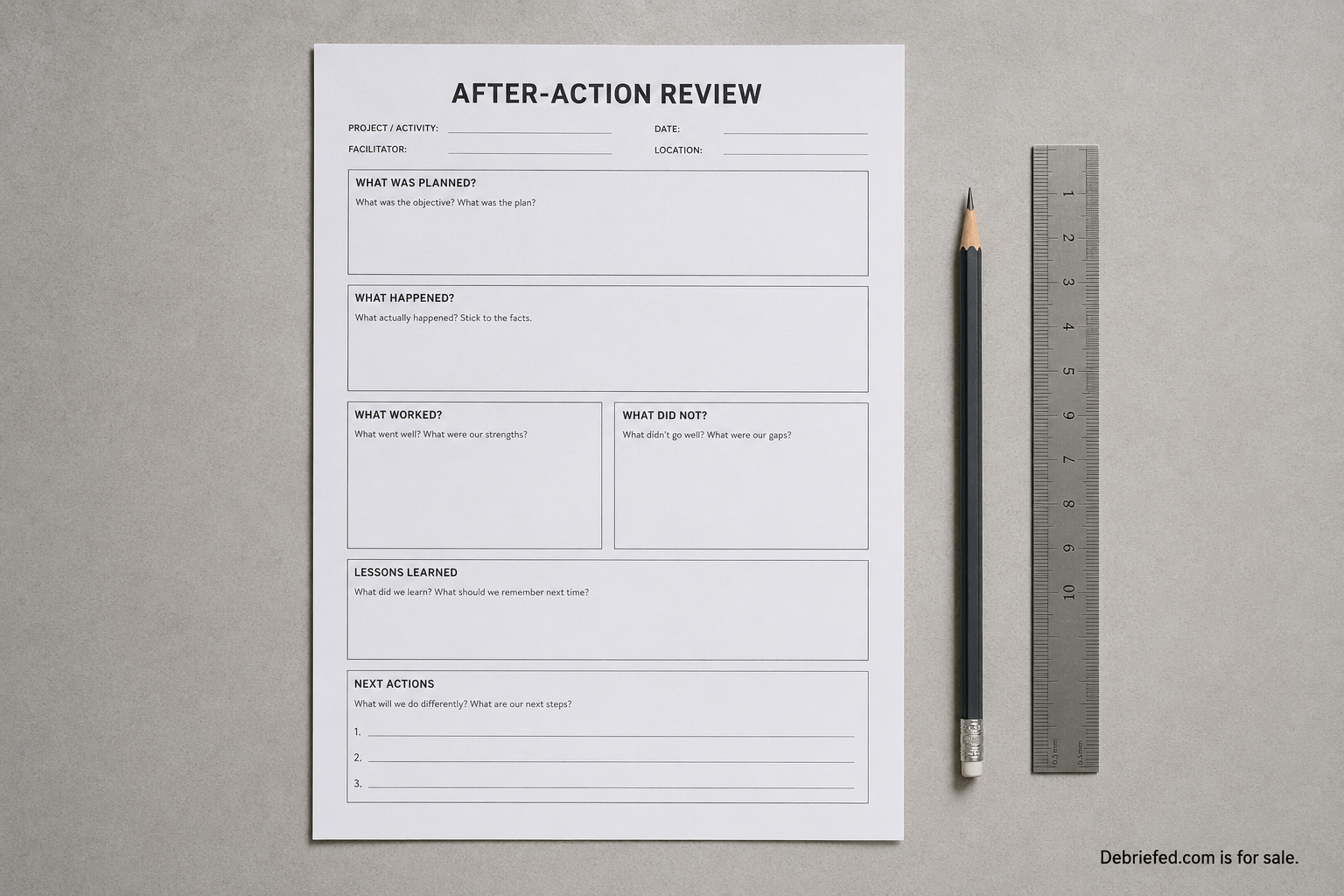
An after-action review is a structured conversation held soon after completed work. Its purpose is to compare what the team intended with what actually happened, understand the causes behind important differences, and assign changes before memory fades. The method is simple enough for a short project and disciplined enough for a major event. The quality comes from preparation, candid evidence, and follow-through.
Schedule the review while the sequence is still recoverable. A window of twenty-four to forty-eight hours works for many ordinary events, though safety, recovery, or evidence collection can justify more time. Put the review on the calendar before the work begins when possible. Participants then understand that observation and learning are part of completion rather than an optional meeting added later. See monday.com’s AAR overview for a useful public treatment of this part of the work.
Invite people who directly planned, performed, supported, or observed the work. A room filled only with managers produces a secondhand account. A room that is too large can suppress detail. Choose the smallest group that represents the important perspectives, then collect written input from others who hold facts the group will need.
Name a facilitator who can protect the process without defending the outcome. The facilitator opens with the event boundary, intended result, available evidence, and ground rules. They manage time, draw out quieter participants, pause unsupported conclusions, and keep seniority from deciding factual disputes. They should be independent enough to challenge the first convenient story. See Deckary’s AAR template guidance for a useful public treatment of this part of the work.
Begin with the first question: what was supposed to happen? Use the plan that existed before the event, including objectives, roles, measures, assumptions, and decision points. This is not a chance to improve the plan retrospectively. The group needs the original intent because the difference between plan and reality creates the material for the rest of the review.
Ask what actually happened and build a shared sequence. Use timestamps, records, work products, system data, and direct observations. Let participants write independently before discussion so the first speaker does not anchor everyone else. Mark uncertainty openly. A disputed fact should remain disputed until evidence resolves it.
Next ask why the result differed. Move past labels such as communication problem or human error. Examine the conditions that shaped behavior: unclear authority, missing information, workload, incentives, handoffs, tools, changing assumptions, and timing. Use repeated follow-up questions carefully. The goal is a causal explanation strong enough to support a useful change. See Wharton Executive Education for a useful public treatment of this part of the work.
Then ask what should be sustained or changed. Preserve successful practices with the same care given to failures. Convert each selected finding into a specific action, owner, due date, and check. Limit the list to changes with real consequence and authority. An enormous action register often protects the meeting from making priorities.
Keep the room candid and specific. A blame-free review still holds people accountable for choices. It simply examines those choices in context and directs criticism toward learning. Leaders can support candor by speaking after junior participants, acknowledging their own assumptions, and inviting evidence that complicates the official account.
Close by reading back the main findings and assignments. Confirm what remains uncertain, who will resolve it, and when the written record will circulate. The facilitator should publish a concise account while the discussion is fresh. Participants need a short period to correct factual errors without rewriting uncomfortable conclusions. See MGRUSH facilitation guidance for a useful public treatment of this part of the work.
Follow-up distinguishes a review from a ritual. Put assigned changes into the team’s normal work system. Revisit them at a defined date and test whether they changed behavior or results. Bring relevant lessons into the kickoff for similar work. The next team should encounter the lesson before the next decision, not after the next failure.
A household event can use the same method at a smaller scale. As a dad in his forties working from home in the northern New Jersey and New York City suburbs, I have seen a busy family plan change quickly when a preschool-age child and two adults need different things at once. A five-minute review with my wife can compare the plan, the actual sequence, the reason for the gap, and one adjustment without turning family life into a corporate exercise.
The meeting length should follow consequence and complexity. A short recurring task may need twenty minutes. A complicated incident may require preparation, separate interviews, and several hours. Keep the four-question spine in either case. More ceremony does not compensate for weak evidence or missing ownership.
Prepare a lightweight checklist for the method and keep it beside the team’s normal planning material. The checklist should name the event boundary, evidence, participants, decision owner, record location, action tracker, and follow-up date. Repetition makes the process easier to start and reduces dependence on one experienced facilitator. The checklist can evolve when reviews reveal a better question or a recurring gap.
Pay attention to language during the session and in the record. Replace broad judgments with descriptions of conditions, behavior, sequence, and consequence. Ask what a camera, system record, or direct observer would have captured. Concrete language makes disagreement easier to examine and gives an action owner a clearer condition to change. It also helps a future reader decide whether the lesson applies in a different setting.
Leaders should review the health of the process across several events. Look for recurring causes, overdue actions, repeated exceptions, and successful practices that deserve wider adoption. This portfolio view can reveal a system issue that no single event makes obvious. Keep the original context attached so aggregation does not flatten different situations into a misleading score.
Facilitators and report owners improve through their own review cycle. After each session, note which question produced evidence, where the group became vague, which participants entered late, and whether the final actions matched the findings. Adjust the next agenda based on those observations. The review method should demonstrate the same learning behavior it asks from the team.
The final test is practical. A review has succeeded when another person can understand what happened, why the finding matters, what will change, who owns that change, and when the team will check the result. A polished meeting without those elements is discussion. A concise record with those elements becomes part of the operating system.