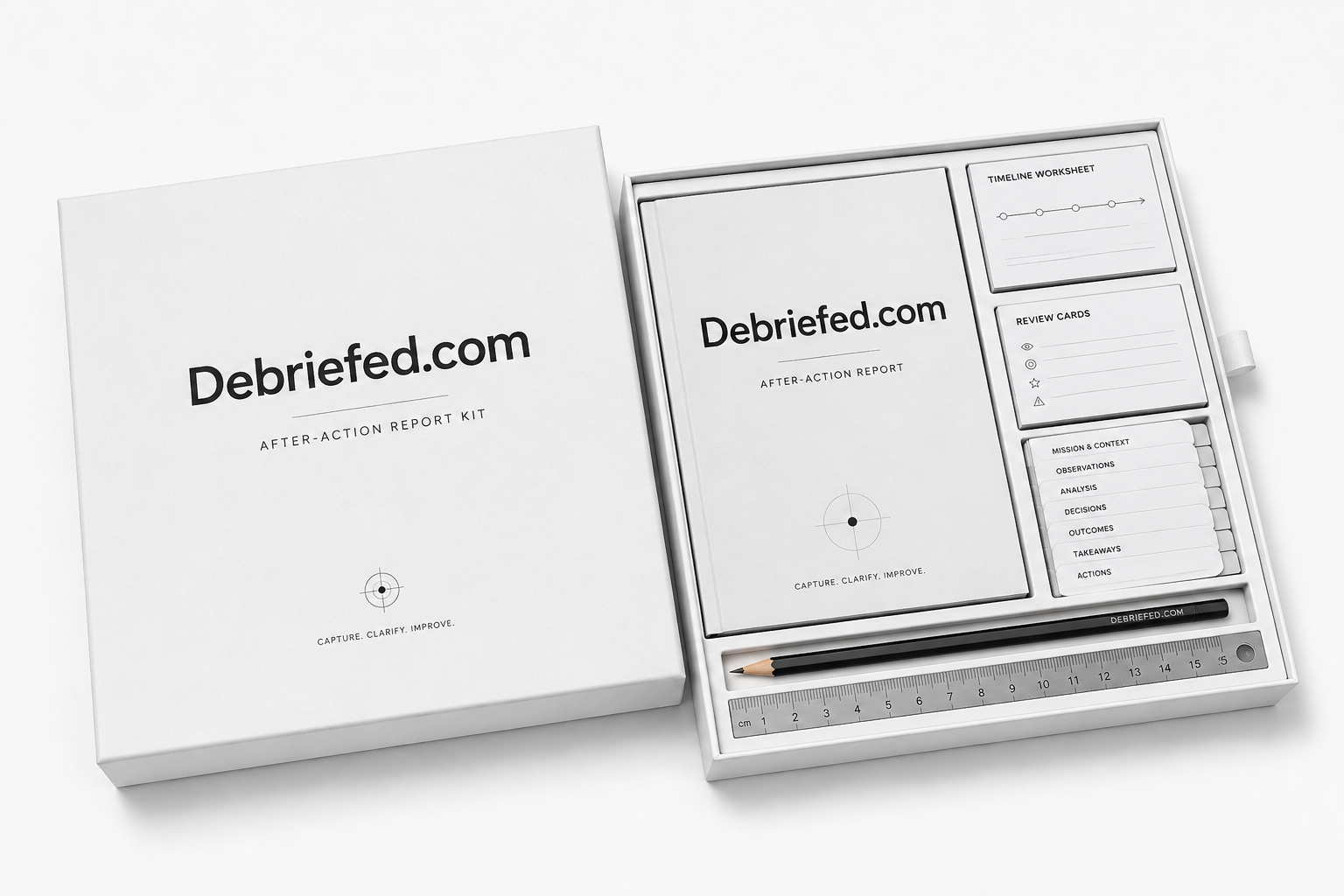
I would build an after-action product around the moment when a team needs to turn fresh experience into a better next attempt. The product would begin after a launch, incident, campaign, or project milestone, while observations are still specific. It would give the group a calm structure for comparing the intended result with the actual result and for carrying the strongest lessons into assigned work.
I see an after-action product as a working business, not a decorative concept. The customer arrives with completed work and a crowded account of what happened. The service earns its place by helping that customer separate observation from interpretation, compare the result with the original intent, and decide what deserves to change. That is a narrow enough job to design carefully and a broad enough job to matter across many kinds of teams.
The first design principle would be a clear beginning. Every review needs a stated event, a time boundary, an intended result, and the people who directly observed the work. I would make those elements visible before anyone starts explaining causes. A shared frame prevents the conversation from drifting into a general performance discussion and gives quieter participants a fair point of entry. See Atlassian’s retrospective guidance for a useful public treatment of this part of the work.
The second principle would be evidence before confidence. People remember vivid moments and often turn a partial view into a complete story. I would ask participants to place facts, timestamps, decisions, and changes in sequence. Different accounts could remain side by side until the group has enough evidence to reconcile them. Productive disagreement is useful when the system preserves it accurately.
I would organize the live session around a short sequence rather than an open text box. Participants would first write independently, then compare accounts, then explore causes, and finally commit to changes. Independent input reduces anchoring. A visible sequence keeps diagnosis from being rushed by the understandable desire to start fixing things. See Asana’s project retrospective overview for a useful public treatment of this part of the work.
The experience should lead toward a small number of consequential findings. A long list can feel thorough while hiding the few things that would genuinely improve the next attempt. I would ask which condition most affected the result, which successful behavior should become standard, and which change has an owner with enough authority to carry it. Precision matters more than volume.
The record should connect every accepted lesson to its source event, supporting evidence, decision, owner, and review date. It should also preserve successful choices worth repeating. Teams often document only failures and lose the conditions that made good work possible. A balanced record gives future teams a more useful starting point.
Trust would be a product feature. Participants need to know who can see raw notes, how attribution works, when a record becomes final, and what can be amended. Sensitive reviews may require separated access, retention rules, or a facilitator who can summarize without exposing a source. Those choices should be explicit rather than buried in settings. See Notion’s help center for a useful public treatment of this part of the work.
The business model would follow the frequency and consequence of the review. A small team might pay for a repeatable workflow. A larger organization might value facilitation, governance, integrations, or a structured archive. I would resist adding features merely to make a larger menu. Each addition should help a team prepare, observe, explain, decide, assign, or retrieve.
A useful early version could be tested with teams that already conduct reviews. Their current workarounds reveal the real standard: meeting documents, whiteboards, recordings, ticket systems, and folders full of reports. I would watch where context gets lost, where discussion stalls, and which agreed actions disappear afterward. The product should replace friction, not invent a new ceremony. See Linear for a useful public treatment of this part of the work.
The name Debriefed.com gives this direction an unusually clear front door. It says what has happened without dictating a single method or market. The operating challenge is to deserve that clarity by building a service that respects participants, produces a reliable account, and improves the next decision.
I would also define success in operating terms. The service should shorten preparation, increase the range of useful observations, produce fewer ambiguous assignments, and make prior findings easier to reuse. Those measures keep the company accountable to the customer’s actual review work. They also give an early team concrete signals for deciding which parts of the method deserve deeper investment.
I founded i-Newswire.com in 2007 and later developed iNewswire.com. That experience taught me that workflow products become valuable through repeated, ordinary use. The strongest version of this idea would make the next review easier because the last one left behind better structure.