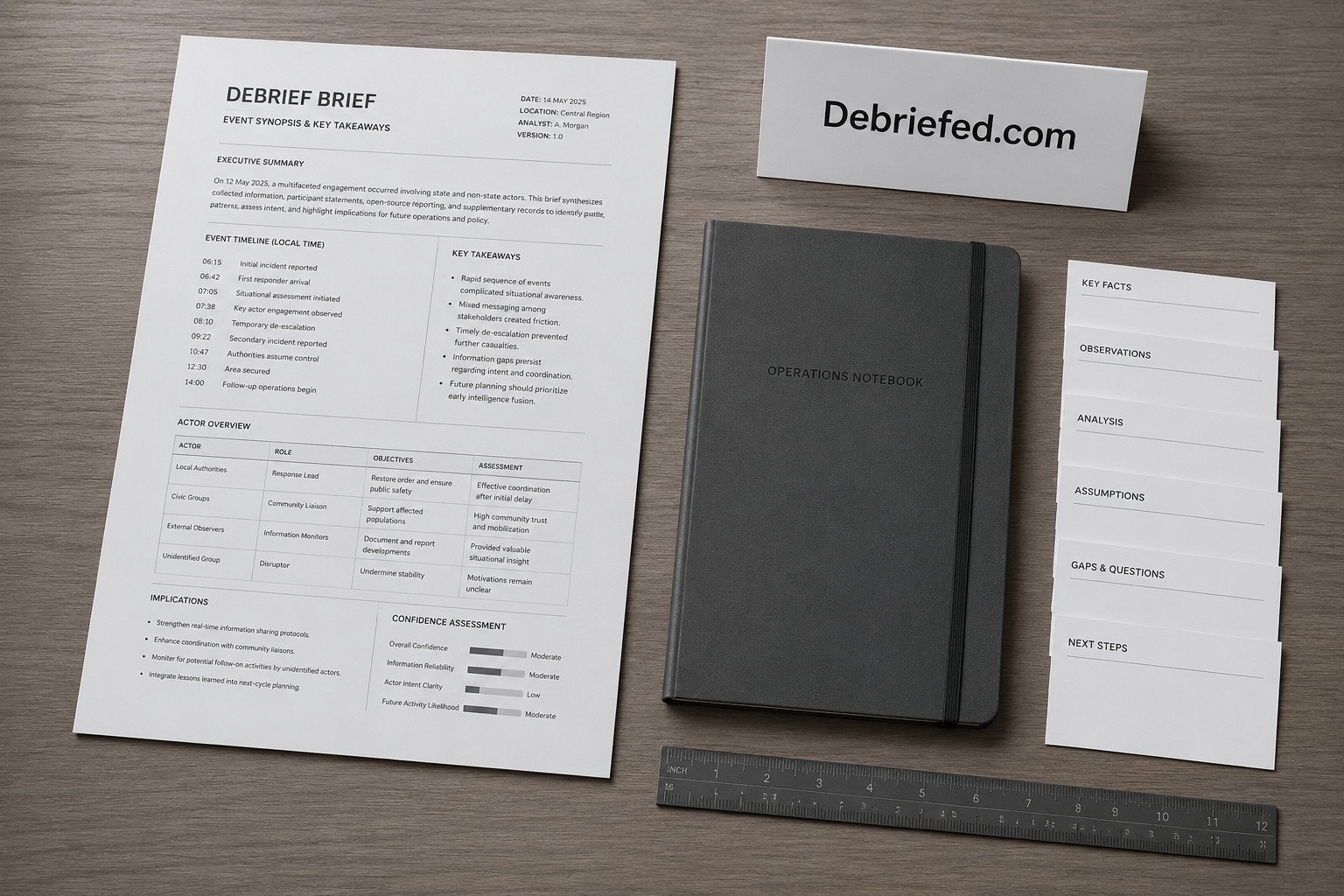
I would approach an intelligence debrief desk as a disciplined collection service. The work begins when a person returns from a mission, source meeting, flight, field visit, or other event with observations that may matter beyond the immediate team. The desk would help recover detail while memory is fresh, distinguish direct observation from inference, and route the resulting record to authorized users.
I see an intelligence debrief desk as a working business, not a decorative concept. The customer arrives with completed work and a crowded account of what happened. The service earns its place by helping that customer separate observation from interpretation, compare the result with the original intent, and decide what deserves to change. That is a narrow enough job to design carefully and a broad enough job to matter across many kinds of teams.
The first design principle would be a clear beginning. Every review needs a stated event, a time boundary, an intended result, and the people who directly observed the work. I would make those elements visible before anyone starts explaining causes. A shared frame prevents the conversation from drifting into a general performance discussion and gives quieter participants a fair point of entry. See the CIA’s public site for a useful public treatment of this part of the work.
The second principle would be evidence before confidence. People remember vivid moments and often turn a partial view into a complete story. I would ask participants to place facts, timestamps, decisions, and changes in sequence. Different accounts could remain side by side until the group has enough evidence to reconcile them. Productive disagreement is useful when the system preserves it accurately.
Preparation would establish what the organization needs to learn without scripting the witness into expected answers. The interviewer would use a timeline, open questions, and careful follow-ups. Contradictions would be recorded as information requiring resolution. The desk would avoid performance theater and focus on provenance, specificity, and relevance. See the Office of the Director of National Intelligence for a useful public treatment of this part of the work.
The experience should lead toward a small number of consequential findings. A long list can feel thorough while hiding the few things that would genuinely improve the next attempt. I would ask which condition most affected the result, which successful behavior should become standard, and which change has an owner with enough authority to carry it. Precision matters more than volume.
Every report would carry source context, confidence, handling rules, unanswered questions, and distribution limits. A later analyst should be able to tell what was seen, what was heard from another person, and what the interviewer inferred. That separation protects both the contributor and the usefulness of the record.
Trust would be a product feature. Participants need to know who can see raw notes, how attribution works, when a record becomes final, and what can be amended. Sensitive reviews may require separated access, retention rules, or a facilitator who can summarize without exposing a source. Those choices should be explicit rather than buried in settings. See the Defense Intelligence Agency for a useful public treatment of this part of the work.
The business model would follow the frequency and consequence of the review. A small team might pay for a repeatable workflow. A larger organization might value facilitation, governance, integrations, or a structured archive. I would resist adding features merely to make a larger menu. Each addition should help a team prepare, observe, explain, decide, assign, or retrieve.
A useful early version could be tested with teams that already conduct reviews. Their current workarounds reveal the real standard: meeting documents, whiteboards, recordings, ticket systems, and folders full of reports. I would watch where context gets lost, where discussion stalls, and which agreed actions disappear afterward. The product should replace friction, not invent a new ceremony. See a public professional discussion of intelligence debriefing for a useful public treatment of this part of the work.
The name Debriefed.com gives this direction an unusually clear front door. It says what has happened without dictating a single method or market. The operating challenge is to deserve that clarity by building a service that respects participants, produces a reliable account, and improves the next decision.
I would also define success in operating terms. The service should shorten preparation, increase the range of useful observations, produce fewer ambiguous assignments, and make prior findings easier to reuse. Those measures keep the company accountable to the customer’s actual review work. They also give an early team concrete signals for deciding which parts of the method deserve deeper investment.
The strongest company in this direction would pair skilled interviewers with secure, restrained tools. Technology can support preparation, transcription, search, and routing. Human judgment remains central wherever trust, ambiguity, sensitivity, and follow-up questions shape the quality of collection.